Selasa, 05 Juli 2011

AS202BRAVO PAPERCRAFT

FFA AS-202 Bravo

From Wikipedia, the free encyclopedia
AS/SA 202 Bravo
Role Civil light aircraft
National origin Switzerland/Italy
Manufacturer FFA/SIAI-Marchetti
First flight 9 March 1969
The AS/SA 202 Bravo is a two to three-seat civil light aircraft jointly designed and manufactured by the Swiss company Flug- und Fahrzeugwerke Altenrhein (FFA) and the Italian company Savoia-Marchetti. The aircraft was designated the AS 202 in Switzerland, and the SA 202 in Italy.
Savoia-Marchetti manufactured the wings, undercarriage and engine installation, while FFA manufactured the fuselage, tail and controls, while both companies had assembly plants manufacturing the complete aircraft.
The first Swiss model flew on 9 March 1969, the first Italian aircraft following on 8 May.
Bravo is a rugged all-metal low-wing monoplane with a full vision canopy. Its tricycle landing gear is fixed.
34 15s and 180 18s were built, with most in service with military customers. The biggest civil operator is Patria Pilot Training at Helsinki-Malmi Airport, Finland.


AS/SA 202-10
With 115 hp Lycoming O-235-C2A engine
AS/SA 202-15
With 150 hp Lycoming O-320-E2A engine, fixed pitch propeller, optional third aft seat
AS/SA 202-18A
With 180 hp Lycoming AEIO-360-B1F engine, constant speed propeller, third aft seat, fully aerobatic.
AS/SA 202/26A
With 195 kW (260hp) Lycoming AEIO-540 engine. Only one aircraft manufactured so far.
AS 32T Turbo Trainer
Two-seat tandem trainer aircraft, powered by a 268 kW (360-hp) Allison 250-B17C turboprop engine. Only one aircraft manufactured.

Operators

Civil Operators

  •  Finland
    • Patria Pilot Training - 7 aircraft. Patria's Bravos are ex-British Aerospace Flying College aircraft. BAE Flying College owned 11 aircraft, but 1 was lost in Scotland claiming 2 lives. Remaining 10 aircraft were sold to private Finnish flying school Pilot Factory, which merged with Patria in 2004-2005.
7 aircraft out of original 10 remain in service. During merger with Patria, one aircraft was sold to private owner. Night-time accident at Helsinki-Malmi airport in 2002 claimed no lives but hull was damaged beyond repair. In August 2010 one aircraft veered off the runway at Helsinki-Malmi and was written off.

Military Operators

 Specifications (202-10)

Data from [1]
General characteristics
  • Crew: One, pilot
  • Capacity: One or two passengers
  • Length: 6.65 m (21 ft 9¾ in)
  • Wingspan: 9.8 m (32 ft 2 in)
  • Height: 2.51 m (8 ft 2¾ in)
  • Wing area: 13.16 m² (141.58 ft²)
  • Empty weight: 486 kg (AS 202-18A4 742 kg[2]) (1,069 lb)
  • Max takeoff weight: 852 kg (AS 202-18A4 1,080 kg[2]) (1,874 lb)
  • Powerplant:Lycoming O-235-C2A 4-cylinder air-cooled horizontally-opposed piston engine, 86 kW (115 hp)
  • Max landing weight : AS 202-18A4 1,050 kg (from Wikipedia)


AS202 BRAVO TNI AU

  • AS-202 BRAVO
    AS-202 Bravo aircraft Indonesian Air Force use since 1981, after four aircraft arrived at Tanjung Priok Port on March 28, 1981 using a container. Halim Perdanakusuma assembled at the air base by Indonesian Air Force technicians and then flown to the air base as a base LANUD Adisucipto and used by the School of Aviation (Sekbang) Army / Air Force. (http://ceriwis.us/showthread.php?t=573)
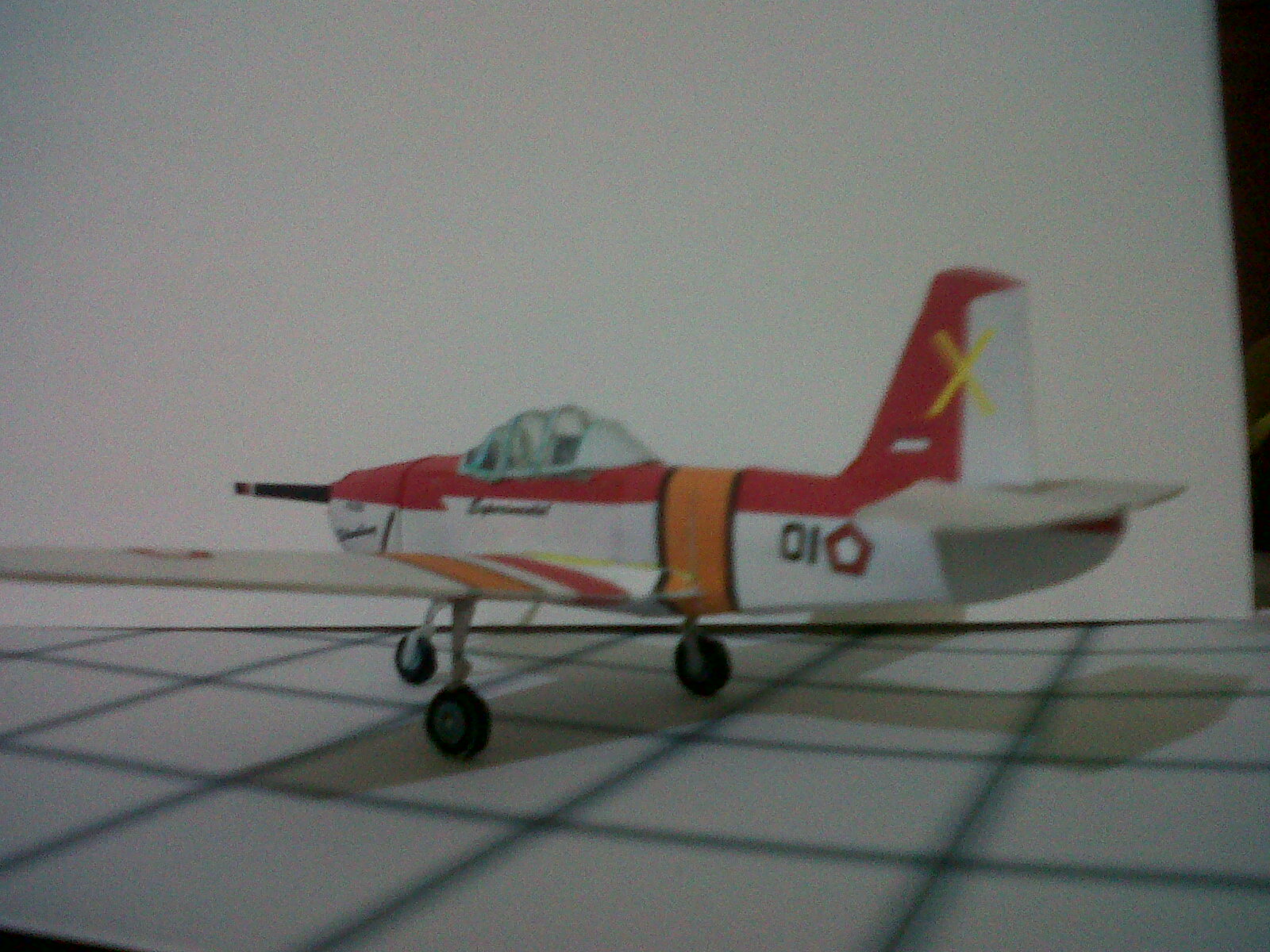
Papercraft AS202BRAVO TNI AU 1:40

After several weeks of looking for inspiration, finally I can  complete the model of the AS202 BRAVO with Air Force markings.
Why did I make with the Air Force markings? Because of my love for the world aerospace in Indonesia, especially the Indonesian Air Force.
This papercraft model that I designed myself ... please download ... and good luck


Password: as202

Kamis, 16 Juni 2011

The Stout "Sky Car"


William Bushnell Stout was a prolific designer of road vehicles and aircraft, including the Ford Trimotor series. He was founder of the Stout Metal Airplane Division of the Ford Motor Company and in 1931 designed the Skycar which was specified for easy handling and provided with automobile-style comfort. Single examples of four variations on the basic design were produced between 1931 and 1944.[1]
The Skycar I was first displayed at the spring 1931 Detroit Show. The aircraft was a two-seat high-wing monoplane, accommodating the occupants in tandem layout. It had an all-metal steel-tube frame covered with corrugated metal skin. Centre-line nose and tail-wheels plus a standard landing gear were fitted. The rear fuselage was constructed from an open framework carrying a single fin and rudder, inside which was located the rear pusher engine.[2] Fuel was carried in two tanks in the leading portion of the central section of the engine housing, from where it was fed by gravity to the engine.[3] At a later date the aircraft was fitted with twin booms carrying the single fin and rudder (see photo of preserved aircraft).

The Skycar I, sometimes referred to as the Model 11-W. It was flown as a personal aircraft by Stout for several years [7] and was later donated to the Smithsonian Institution. It is now (2009) on display in the National Air and Space Museum at Dulles Airport Virginia.


Skycar I
75 hp (56 kW) Michigan Rover R-267 pusher engine, later 90 hp (67 kW) Warner Junior. (1 built)

Specifications (Skycar I)

Data from Aerofiles
General characteristics
  • Crew: 1
  • Capacity: 1 passenger
  • Length: 24 ft 0 in ( m)
  • Wingspan: 43 ft 0 in ( m)
  • Useful lift: 480 lb ( kg)
  • Powerplant: 1 × Michigan Rover R-267, 75 hp ( kW)
Performance
  • Maximum speed: 95 mph ( km/h)
  • Cruise speed: 80 mph ( km/h)
  • Stall speed: 35 mph ( km/h)
  • Range: 320 miles ( km)                                                                                                                                                                                                                              (From Wikipedia )
Papercraft The Stout  1:40 Scale

Design by: Dani Hamdani
Build by: Yopi Wibisana


Download Pattern on Progress...

Senin, 13 Juni 2011

NU 200 Sikumbang

From Wikipedia, the free encyclopedia


The LIPNUR Sikumbang (manufacturer designation X-01) was a low-wing monoplane of mixed construction built in Indonesia in 1954 as a COIN and anti-guerilla-warfare aircraft. Of conventional configuration, it had fixed tricycle undercarriage and seated the pilot under a bubble canopy. A single example was built under the designation NU-200 in 1954, and another as the NU-225 in 1957. The latter machine was grounded in 1967.

Specifications (NU-200)

General characteristics
Performance
  • Maximum speed: 260 km/h (160 mph)
  • Range: 960 km (600 miles)

PAPERMODEL AIRCRAFT OF NU200 Sikumbang 

With pride and admiration as well as full respect to Mr. Nurtanio who have contributed thoughts and energy for the nation and the state of Indonesia, then I make a replica of the plane NU 200 Sikumbang with 1:72 scale. May we all as citizens of the Indonesian nation was proud of Indonesia and the love of domestic products.


Kamis, 09 Juni 2011

KT-1B Wong Bee Jupiter Aerobatic Team Papercraft


KT-1B aircraft Wong Bee made ​​in South Korea by the Korean Aerospace Industry (KAI). The turboprop engine aircraft has the ability and acrobatic maneuvers that either making it suitable to be used as a training tool for prospective military pilots.

In the country of origin, the plane that can go with the speed of 648 km / h, it began to be used by the South Korean Air Force in 2000. Besides Indonesia, Korean Trainer (KT) is also used by the Turkish Air Force.

Indonesia using the version of the KT-1B from the end of 2003. In this version, the KT-1 modified to allow the pilot to prepare for the skills of flying a supersonic jet fighter aircraft.

KAI sent seven aircraft plus spare parts to Indonesia and also provide training for pilots and mechanics Indonesia to fly and maintain aircraft. In 2006 the Air Force re-buying 12 KT-1B aircraft.

In addition to practice maneuvers, Woong Bee also be armed. In KAI website was a picture of KT which is equipped with rocket launchers and missiles on both wings. (DetikNews)

Jupiter Aerobatic Team

Jupiter Indonesia Air Force aerobatic team aerobatic display team flying with six Woong Bee KT-1B aircraft painted with red and white colors of Skadik (Squadron Education / Training Squadron) 102, Adisutjipto AFB, Yogyakarta. The plane of Jupiter's team is equipped with a generator of white smoke. The pilot of the Jupiter aerobatic Team (JAT) all instructors. The team is named "Jupiter" after the call sign of the TNI-AU (Indonesian National Army - Air Force / Indonesian Air Force) instructor


HistoryIn 1996 the new Indonesian Air Force aerobatic team was formed and equipped with eight Hawk Mk.53 aircraft of Skadik 103. The team is named Jupiter and for the first time in 23 September 1997, but in 2001 became the team along with Blue Jupiter Blue Eagle.Jupiter aerobatic team (JAT) was established back in 2008, using a 4 Korea Aerospace KT-1B Woong Bee of 102 Training Squadron, Adisutjipto AFB, Yogyakarta. The team's first public show on July 4, 2008 in Yogyakarta, and their second in Jakarta, November 2008.In 2010 after two years of stagnation, JAT began a training program with the help of a team featuring Australian roulettes. In September 2010 two Jupiter pilot team has been sent to Australia to observe and learn to fly together with roulettes maneuvers at their home base at East Sale, Victoria, Australia. On Nov 8, 2010 at roulettes performed at Halim Air Force Base, Jakarta where six JAT members have the opportunity to fly in the backseat of roulettes PC-9s during their training.
Jupiter in 2011 increased to six aircraft and receive the new livery of red and white colors as the color of the flag of Indonesia. Jupiter Team aerobatic aircraft KB-1B also receive a white smoke generator. The first demonstration with the composition of the new six-ship formation made March 16 in Yogyakarta at a ceremony launching a new uniform with AF Indonesian. Airshow second on 9 April in Jakarta on the 65th anniversary of the Air Force and the third on April 17, 2011 in Yogyakarta. (Aerobatics Team website)


PAPERCRAFT


Background of the manufacture of KT-1B Wong Bee Papercraft  is love for the world aerospace Indonesia. where the maker had to lift the image of Indonesia in the world and make papercraft Wong Bee KT-1B is to be the first with Indonesian Air Force decal (Jupiter Aerobatic Team). With approximately one month to design this plane and the moment at which the Indonesian Air Force's birthday


download Patern

Pengikut